The History of the Wearside League
Formation 1892
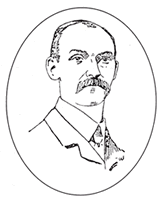 Charles Kirtley
The origins of the Wearside League can be traced back directly to one man: Charles Kirtley. He was secretary of the Sunderland Swifts club in the early 1890s, which played friendlies against other amateur teams on Wearside.
Kirtley recognised the need for some form of league competition for local clubs (the Monkwearmouth Charity Cup had started 3 years before). The Football League had been formed only four years before in 1888.
Two years later the area had its first League club when Sunderland were elected. In a letter published in the Sunderland Daily Post and Herald on June 15th 1892 (a similar letter appeared in the Sunderland Daily Echo the following day) Kirtley outlined his plans for a local league.
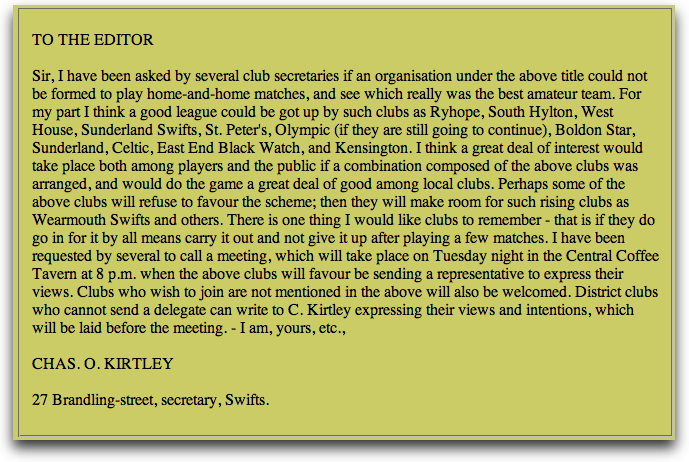
At the subsequent meeting the foundations of the Wearside League were laid. The clubs that formed the first competition were: Seaham Harbour, Sunderland Swifts, Monkwearmouth, Ryhope Colliery, Boldon Star, Sunderland Celtic, East End Black Watch, Wearmouth Swifts, Seaham Albion, South Hylton and Sunderland West End. Kirtley became the League's first secretary, while John Jackson was made chairman. Major Ernest Vaux became the first president and Captain T.W. Pinkney, J. Marr and R. Thompson were made vice-presidents. John Reay was elected treasurer.
THE FIRST SEASON
The Wearside League's first season got underway with eleven clubs competing. Inevitably the new league had its teething troubles. The quality of the grounds were not of a high standard, most did not have the facilities to take a 'gate'. For example, East End Black Watch played on the Town Moor. Sunderland Swifts played at Abbs Field, Fulwell, which a decade before had been the home of Sunderland Football Club. A club called Roker Park, which later joined the Wearside League, also played at Abbs Field. Because most clubs could not charge an admittance fee the League set club subscriptions at only 5/- (25p).There was also the problem of clubs not fulfilling fixtures. On October 1 st 1892, Black Watch were supposed to meet at the town's railway station at '1.40 prompt' to travel to Boldon for a match. However, the Boldon Star secretary received a telegram at 3.30 p.m. stating that the Black Watch could not raise a team. The home side kicked a goal and claimed the match.
In the following January, Sunderland Celtic and Seaham Albion were due to play a League match, but the game was called off because Celtic could not raise a team and the Albion players did not appear at all.
Even when both teams turned up the weather sometimes had a hand to play. On January 9th 1893, the game between Sunderland West End and Sunderland Swifts on a snow covered Hylton Road Ground, had to be delayed until the referee arrived.
Cancellations and re-arranged games in turn caused fixture pile-ups. Black Watch were scheduled to play two games on the afternoon of April 8th 1893. At 2.30 they kicked-off against West House in the Monkwearmouth Charity Cup on the Town Moor.
They planned to make only one team change against Seaham Albion at 5.00 p.m. However, the game was abandoned, no doubt to the relief of the Black Watch players, who had been beaten 6-3 in the cup-tie.
South Hylton started the season but did not complete their programme, leaving ten clubs who went the course.
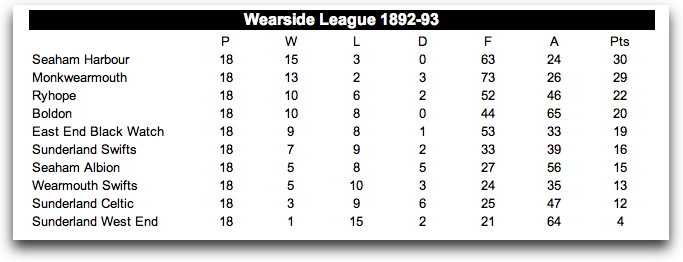
The first ever Wearside League Championship was not decided until the last game of the season, Seaham Harbour eventually took the title by one point from Monkwearmouth.
MONKWEARMOUTH CHARITY CUP
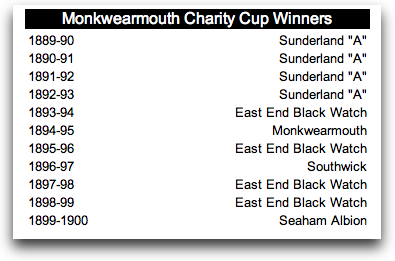
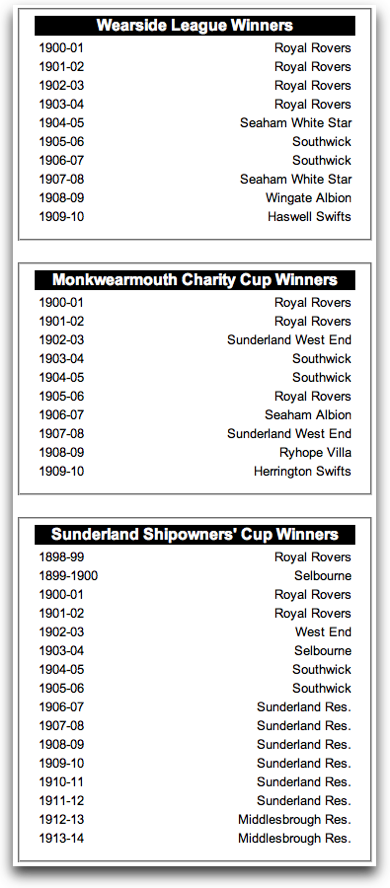
Despite the Monkwearmouth Charity Cup having started three years before the Wearside League was born, by the close of the 1892-93 season, there had still only been one winning club. That season Sunderland "A" team lifted the trophy for the fourth successive year (a record never equalled).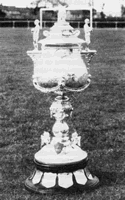
The trophy had been donated by Councillor Robert Thompson and money raised from the competition went to Monkwearmouth Hospital (in the days before the N.H.S.). To this day funds raised by the Monkwearmouth Charity Cup go to the hospital.
In the first year of the Wearside League its members set out to break the dominance of the Sunderland "A" team. In the first round Black Watch drew a crowd of 2,500 spectators for their match against Bishopwearmouth C.I. on the Town Moor. The home side ran out 4-1 winners.
In the same round Sunderland "A"s received a bye and then went on to beat Sunderland Swifts 6-0 in the next round.In the semi-final they beat West House, who had knocked out Black Watch in the previous round.
Sunderland "A" team then met Southwick in the Final at Newcastle Road. Southwick had reached that stage with a walk-over and victories over Monkwearmouth and Ryhope Colliery. A crowd of about 1,500 greeted the Cup Finalists. The Sunderland Daily Echo's football correspondent was not impressed with Sunderland "A" team's attire. He reported "both teams were uproariously welcomed. They presented a striking contrast, the A's wearing a washed-out edition of the red and white striped shirts of the seniors, while the "Suddickers" sported blue shorts, and presented a workmanlike exterior." The Sunderland second-string proved too strong for the Wearside League side and ran out 3-1 winners, thus maintaining their 100 per cent record in the competition.
1890's
In the early days of the League, the only source of income was from benefit games. One such game was played at Seaham Harbour on April 22nd, 1893. A Representative team of League officials turned out against the League Referees. Before the match the East End Brass Band headed a parade around the streets of the village. A large crowd gathered for the game, including a great number of ladies. The Referees were dressed for the occasion in female costume. The carnival atmosphere was maintained with the band playing during the game. The Representative side won the game 5-4, but the score was academic.
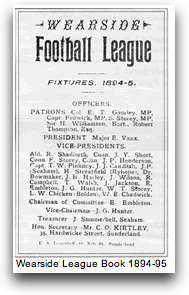
The Wearside League Rules of 1894-95 season, stated: "The League will play two benefit matches, one on Christmas Day and the other on Good Friday, and no League club to play any match on those dates.
Some of the original members of the Wearside League had unusual origins. For example, East End Black Watch was formed with the sole purpose to assist a brass band. A number of men from the East End of Sunderland had the idea of forming a brass band and this was achieved in 1887. Many of the East End Prize Band were paying members but did not play instruments, they did, however, play football. The officials knew that by keeping the men together their interest in the band would be maintained. Therefore, they helped them form a football club: East End Black Watch. The title Black Watch did not have a local connection, a committee man thought "the name would encourage the players to succeed as had the famous Highland regiment."
On April 19th, 1893 a game was played on the Town Moor between Black Watch and the East End Brass Band, with the referee in Chinese costume. A collection was taken during the match for the benefit of the band.
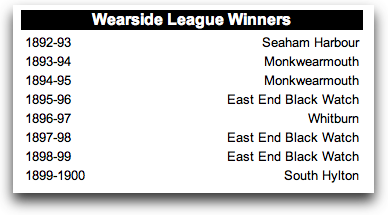
Black Watch soon found success in the Wearside League, winning the championship in 1895-96 and then a further two titles in 1897-98 and 1898-99 seasons followed. Victories were also gained in the Monkwearmouth Charity Cup, Black Watch won the trophy four times before the end of the century.
Another of the successful early clubs, Royal Rovers, had the most humble of beginnings. The club was formed in 1884 and had at first to play on the sands behind the cattle sheds in Sunderland Docks. The club took its name from the Royal Hotel, which was the house of the grandfather of one of its founders, Ralph Scott.
The club survived on players' contributions, despite the fact that these only stretched as far as purchasing cheap india rubber balls. The club were fortunate that these only cost 4d each, as a number of balls were lost in the sea. From these the club progressed to a second-hand rugby ball. For the second season, the club acquired a better ground and proper ball. Although, while the players scraped together enough to buy an Association case they did not have enough for the bladder and the old rugby one had to do for the rest of the season.
In 1890 W.T. Lazenby became involved with the club and took over as secretary. He remained in this post during the next 14 seasons during which time Royal Rovers won 4 championships, 3 Shipowners' Cups and 2 Monkwearmouth Charity Cups. In 1906, Lazenby took over as chairman of the Wearside League, a post he was to serve until 1924-25 season.
In 1906-07 Royal Rovers left the Wearside League for the North Eastern League, becoming known as Sunderland Rovers.
In 1896-97 a club called Marsden Rescue were admitted to the Wearside League. They took their name from a sea rescue that took place off Marsden. This involved a father and daughter who went out in a rowing boat to save the lives of a number of seamen. On the football field they did not meet with much success, leaving the League after only one season.
1893-4
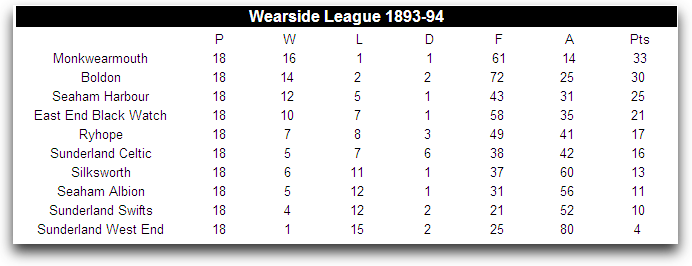
The only change for the second season of the Wearside League was the replacement of Wearmouth Swifts by Silksworth. The championship was won by Monkwearmouth who went on to retain the title.
The second season of the League got off with a bang when defending champions Seaham Harbour met Sunderland Swifts. The game on September 23rd 1893 was played at Seaham and even at that stage of the season was seen as important.
Sunderland Swifts won the game 2-1 but it was not the football that made the headlines. Two days after the match the Sunderland Daily Echo reported:-
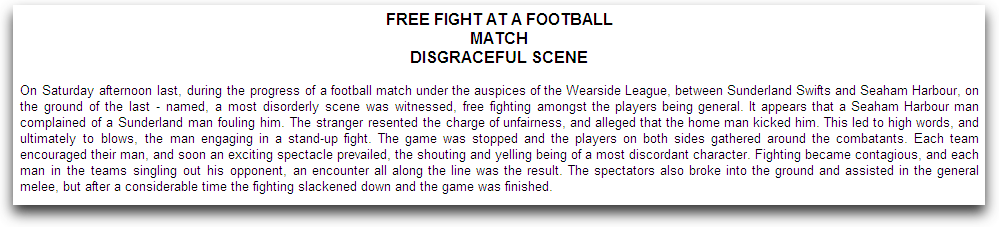
Matters were not helped by the fact that the Swifts secretary was Charles Kirtley who was also the secretary of the Wearside League. He quickly responded to the newspaper article, his letter to the Sunderland Daily Echo appeared two days later.
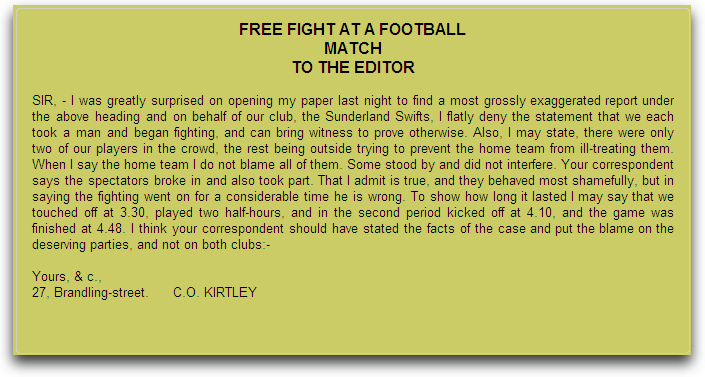
Football at the turn of the century was nothing if not competitive, and the game in the North East has always been played with passion and commitment. What happened at Seaham undoubtedly overstepped the line between what was acceptable and what was not. At the monthly meeting of the League; Milford, Price and Harris of Seaham Harbour and Lambert of Sunderland Swifts were suspended for 14 days for "misconduct upon the field."
Perhaps the reporter at the game also exaggerated things a little, certainly, Kirtley's version of events differed with those printed in the article.
For the 1894-95 season the League was extended to a dozen clubs, which included four new teams. One of these was Seaham Athletic, making up a trio of Seaham sides in the League.
Another of the new clubs was Egypt Rangers. Despite their distant-sounding name, the club was based in the New Hendon district of Sunderland. In the late nineteenth century this area was then known as"Little Egypt" because of the names of a number of streets off Villette Road. These included Cairo Street and Tel-El-Kebir Road.
1900s
The new century began with a Wearside League record that has been equalled but never broken. Royal Rovers took four successive League titles from 1900-01 to 1903-04. The first two championships were also accompanied by both the Shipowners' Cups and the Monkwearmouth Charity Cups. The club's dominance, however, was almost broken in the 1902-03 season by Southwick. The 1902-03 final League table read:
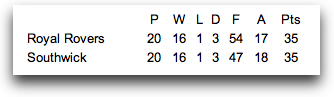
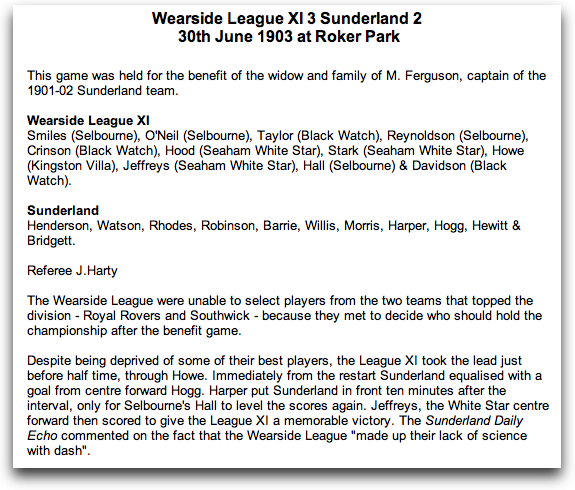
As goal average or goal difference was not then used to separate clubs at the top, a deciding match was arranged to decide who would hold the championship. The game on April 30th was understandably a tense affair. Southwick had the chance to clinch the game and the title when they were awarded a penalty. Unfortunately, Wardle chose the occasion to miss his first penalty in 27 attempts. The game ended level and a second match was needed to decide the fate of the championship.
This game had to be held over until the beginning of the new season. The teams met again at Roker Park on September 23rd. Southwick made the early going but Berry broke away and scored for Royal Rovers. In the second half Brown added a second. Rovers added a third and despite a thick fog settling on the field the match was completed.
The match report in the Sunderland Daily Post the following day stated "the spectators frequently disagreed with the referee's decision, as was shown by their shouting and hissing."
The following season Royal Rovers secured their fourth League championship in a row, despite a late charge from the runners-up Seaham White Star. In a ten-day period White Star played nine matches and took 17 out of 18 points. The Seaham club also carried off the Durham Amateur Cup that season. Between 1904 and 1905 four players joined Sunderland AFC from Wearside League champions Seaham White Star. Kelly, Bell, Tomlin and Holley all went on to make their League debuts for Sunderland.
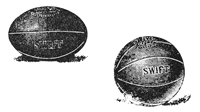
Royal Rovers played with a rugby ball before they could afford a football |
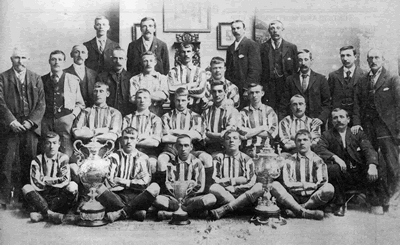
Royal Rovers - 1900-01 |
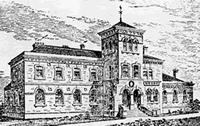
Sunderland Boys' Orphanage is now in use as the East End Community Centre |
The Orphan Asylum was built in Sunderland's East End at a cost of £4,000. It opened for 'inmates' on October 17th, 1861. The boys in the Asylum were from the homes of lost seaman. On average there were 40 boys at the Orphanage at any one time. Their education had a strong nautical flavour. There was a sailing ship in the grounds for instruction in rigging etc. It was not surprising, therefore, that many of the boys went to sea. Between 1901 and 1902 alone, one old boy received the freedom of the borough for service in South Africa, one passed as Extra Master, one as First Class Engineer, one as Mate while another was appointed Master of a Workhouse in Northumberland.
1910s
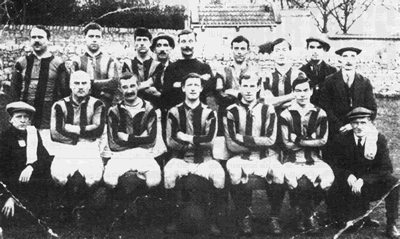
Whitburn's Wearside League team before the First World War. The club had won the title in 1896-97 season.
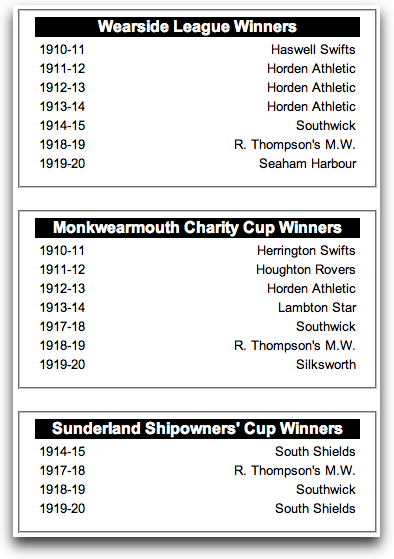
The outbreak of World War One did not bring an immediate halt to the Wearside League. Following the lead of the Football League the season continued to its scheduled close in 1915. Despite a record number of 686 registered players for the season, clubs were finding problems in wartime. Only eight of the original fourteen clubs completed their programme, with Southwick emerging as champions.
Even when the League was suspended for the duration, a "Friendly Group" was run. For the first season of this competition 369 players were registered (about half the usual number). Clubs still found problems in fulfilling their fixtures. Of the 12 that started the season, 4 clubs had to withdraw owing to players enlisting. Murton Colliery headed the table with 24 points. Local charities benefited to the extent of over £100.
The 1916-17 season was headed by R.Thompson's Munition Works after 8 of the original 10 clubs finished the course. Charity matches were arranged and various institutions again benefited to the tune of over £100. A special game was arranged in the Shipowners' Cup between Sunderland Rovers and a Wearside League XI, which raised £76. In 1917-18 season, R. Thompsons won the "Friendly Group" again, with clubs raising over £500 for charity.
The following season the Wearside League returned to its pre-war format. However, things had not fully returned to normal, R.Thompson Munition Works were the first champions and the armaments factory also took the Monkwearmouth Charity Cup.
1920s
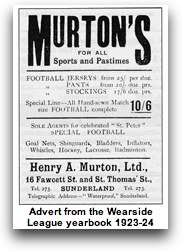
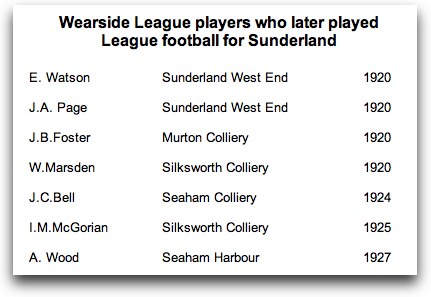
The 1920s saw the rise of the colliery clubs who were to find great success in the Wearside League. R.Thompsons, however, were still a powerful force, having transferred back from munitions work to peace-time production.
At the end of the 1922-23 season, R. Thompsons made a storming finish earning 29 points from the last 16 games (a possible 32 points). The championship was decided on the last match of the season against Seaham Harbour, with both clubs level on points. Thompsons won 2-1 with almost the last kick of the match. Horden Athletic's 1-1 draw with West End the same night snatched the runners-up spot from Seaham Harbour.
R. Thompsons won the title again two years later, but this was to be their last Wearside League success.
The continued popularity of the League was seen in the number of candidates seeking admission. For the 1923-24 season Fatfield Albion and Hetton United were admitted but Hylton Colliery, Shotton Colliery, Washington Colliery, Wingate Constitutional and Hetton Royal Rovers were all turned down.
The mid-week Wearside League game between Hetton United and South wick on April 10th 1924 had to be abandoned owing to darkness.
At a League meeting at the end of the month it was decided it should stand as a completed fixture.
Therefore, Hetton was credited with a 2-1 win.
The club went on to win the League, but the points gained in the abandoned game were not crucial, as the runners-up finished nine points behind.
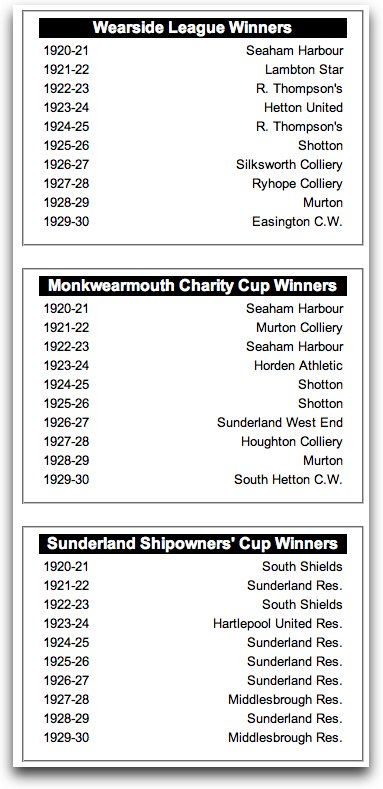
1930s
The Wearside League in the 1930s was completely dominated by the colliery welfare teams. During the decade the list of champions read: Blackball CW (3), Easington CW (2), Seaham CW, Horden CW, Lumley Sixth Pit Welfare, Murton CW and Usworth Colliery. In addition to these: South Hetton CW, Herrington CW, Shotton CW and Murton CW all won the Monkwearmouth Charity Cup.
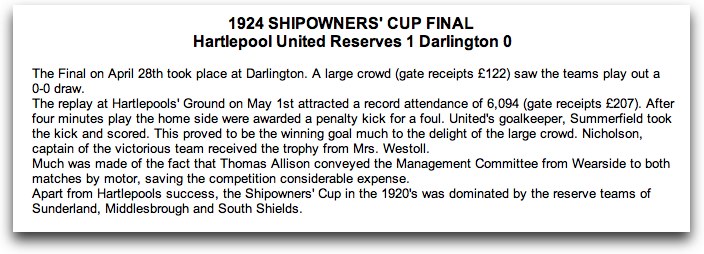
In the 1934-35 season, Blackhall CW even managed to break the stranglehold of Football League clubs' reserve teams on the Shipowners' Cup.
THE LEAGUE CHALLENGE CUP
The 1932-33 season saw the inauguration of a new competition: the Wearside League Challenge Cup. The first competition produced an extraordinary climax, as it took three games before a victor emerged.
Easington CW and Seaham CW met in the final at Horden on May 3rd. Easington took the lead through Nisbett but Lloyd grabbed an equaliser. Dobson restored the lead and then Heslop scored Seaham's equaliser with the last kick of the match.
The replay took place at Murton two days later. Again, there was little to choose between the two teams, with neither side scoring in normal time. In extra time Easington's Dobson broke the deadlock. With less than three minutes of the game remaining Thompson beat the Easington goalkeeper with a free kick from outside the box, but the ball came back from the crossbar. To the surprise of everyone the referee awarded Seaham a goal. Several of the large crowd rushed on the pitch but the goal stood and the game finished all square.
As the season had finished the second replay was held over until the start of the new season. The third attempt to get a result was held at Easington on August 26th.
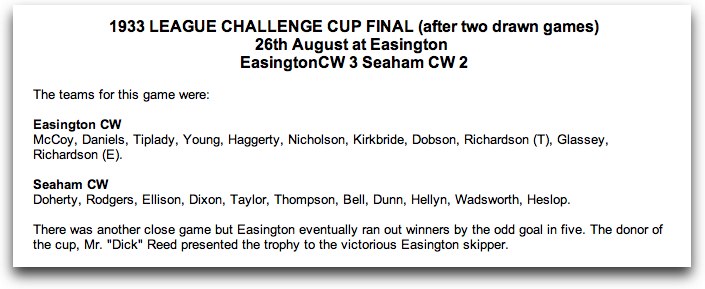
Unfortunately, the League Challenge Cup has gone missing while in the possession of the 1990-91 winners, Dunston Federation Brewery. A replacement trophy had to be presented to IFG Roker when they won the 1991-92 competition.
The strength of the colliery welfare teams was too much for some of their rivals. At their Annual General Meeting in May 1933, Shiney Row Swifts decided to withdraw from the Wearside League. They arrived at this decision only after lengthy debate. The opinion was that the Wearside League mostly comprised of colliery welfare sides "who, in view of their better financial backing, were able to secure better players than other clubs."
In contrast, Easington Colliery Welfare's meeting at the Black Diamond Hotel on May 27th 1933 reported a much healthier state of affairs. On the playing side, the Wearside League had just been won for the third time in four seasons. The team had played 24 league games and 22 cup games during the season, scoring 116 goals and conceding 65. Secretary, Mr. Pallister reported an income of £670 (£130 less than the previous season) and expenditure of £653, leaving a balance of £17. He also disclosed that all outstanding debts had been paid off and the club now had no liabilities.
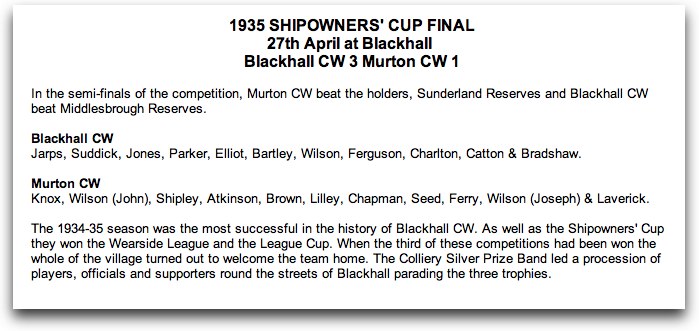
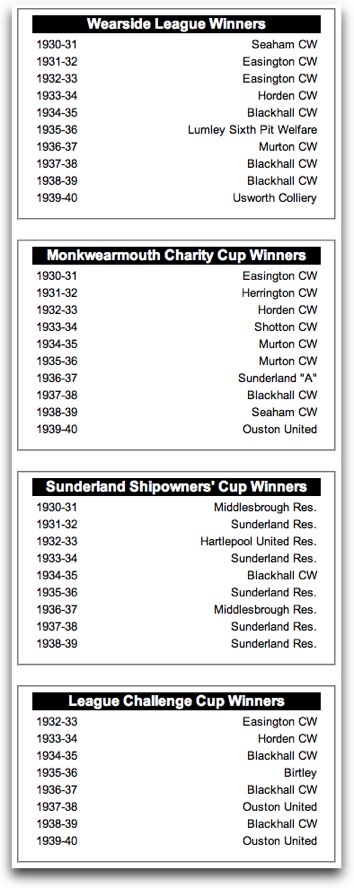
1940s
The Wearside League in the 1930s was completely dominated by the colliery welfare teams. After the outbreak of the Second World War the League carried on until the end of the season and was then put into mothballs for the duration. The same applied to the three cup competitions.
Peace came just in time for the 1945-46 season to get underway. The League consisted of fourteen clubs: Sunderland "A", Shotton CW, Birtley Town, Seaham United, Dawdon CW, Easington CW, Doxford CDS, Felling Red Star, Wearmouth CW, Dawdon Mechanics, Usworth Colliery, Washington Chemical Works, Seaham CW and North Sands.
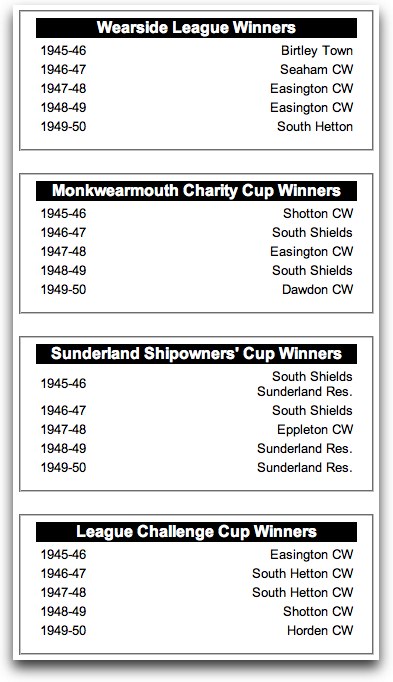
The first post-war champions were Birtley Town, with the League Cup going to Easington CW.
The Monkwearmouth Charity Cup was contested by two Wearside League clubs. Shotton CW ran out 3-1 winners over North Sands, with £116 going to charity.
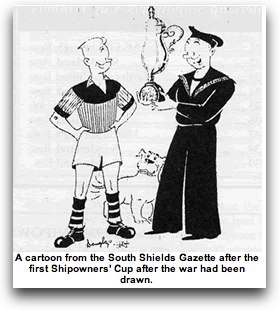
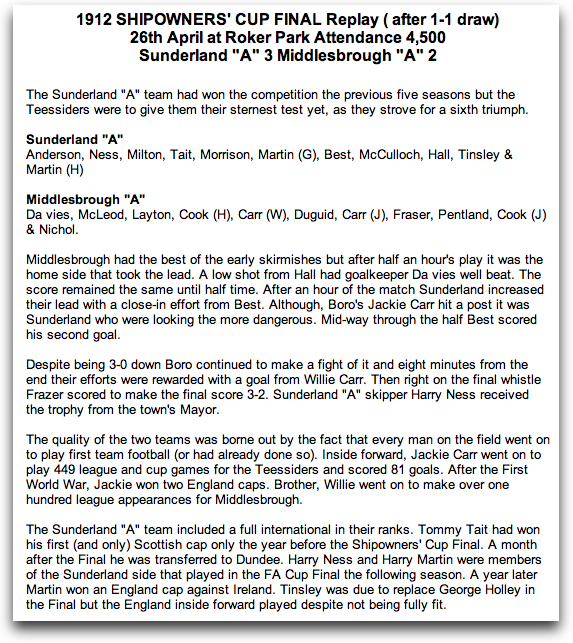
At the meeting of the Shipowners' Cup Committee at the Palatine Hotel on July 20th 1945 it was decided to revive the competition suspended since 1940. The Competition's beneficiary, the Boys' Orphanage, had been occupied by the military during the war (the boys having been evacuated to the country). It was reported to the committee that many of the boys who were there in 1939 had served their country well during the war. In April 1945 a new home for orphans was acquired at Moorhill. While the old Orphanage on the Town Moor had been primarily for orphans of Merchant Seamen, it was decided to consider applications of orphans from the armed services.
The 1946 Shipowners' Cup Final was played on 4th May at South Shields, between Sunderland Reserves and South Shields. A crowd of over 11,000 paid record receipts of £662 13s 6d (beating the previous best of £537).
The game ended in a 1-1 draw and for the only time in the competition's history the teams shared the trophy. After the match the Mayor of South Shields, Alderman Barber handed the cup to the captain of South Shields to keep for six months when it would be handed over to Sunderland. The Mayor also handed each player 15s (75p) Saving Certificates in lieu of medals.
At the end of the record-breaking 1945-46 season the total amount raised by the competition for the Orphanage had reached £7,294 6s 7d.
1950s
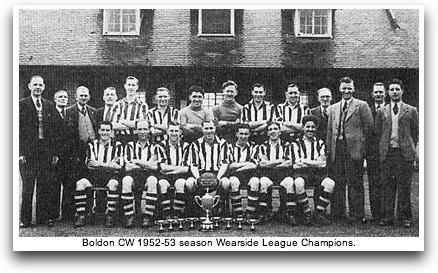
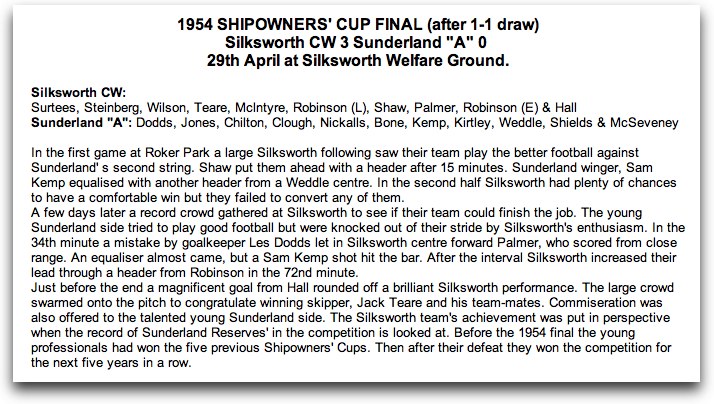
The title of outstanding Wearside League club of the 1950s must go to Shotton CW. Three League championships were won in 1953-54, 1955-56 and 1956-57seasons. In between the first two successes Shotton also took the Monkwearmouth Charity Cup. For one four-year period the League Challenge Cup was completely dominated by the club. From 1953-54 to 1956-57 Shotton won four successive competitions (still a record).
At the end of the 1958-59 season, Blackhall CW had to drop out of the League because of lack of funds. Workmen at Blackhall Colliery used to subscribe a 2d levy for the sport section of the welfare scheme. This used to produce £975 a year, about £18 a week. A reduction in the number of contributors had reduced this figure to about £15 a week and the club had been running at a loss for a few seasons prior to their decision to leave.
This was a problem faced by an increasing number of colliery welfare clubs during the following decade.
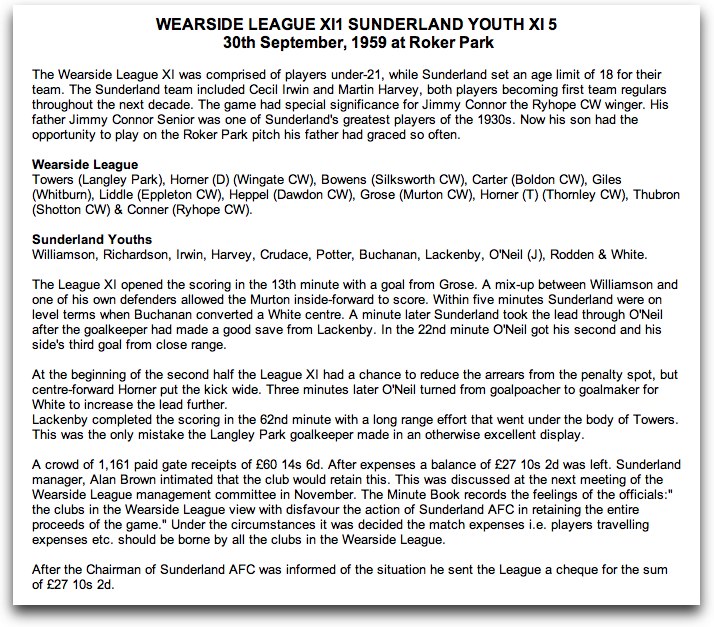
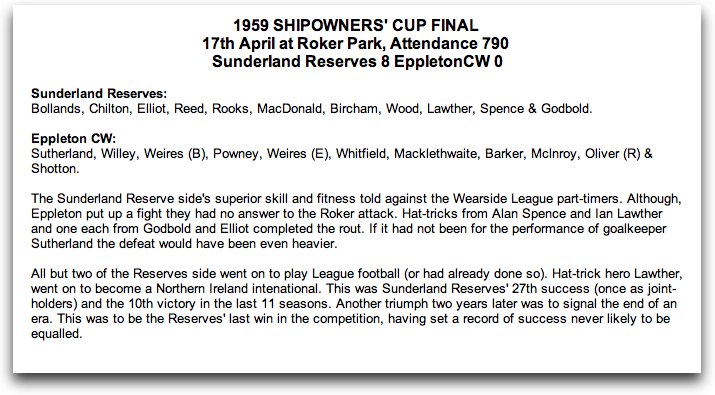
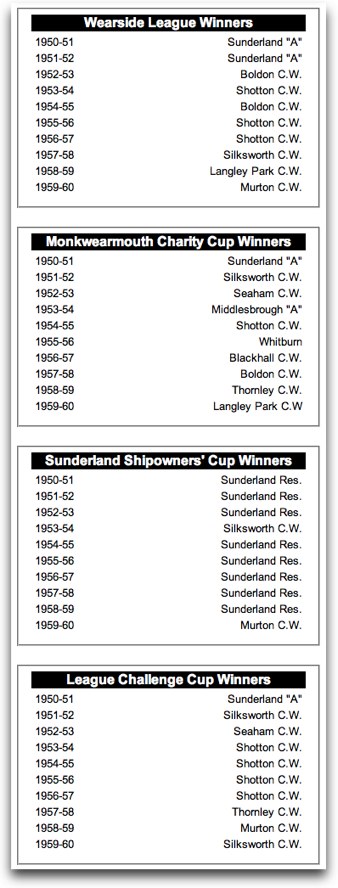
1960s
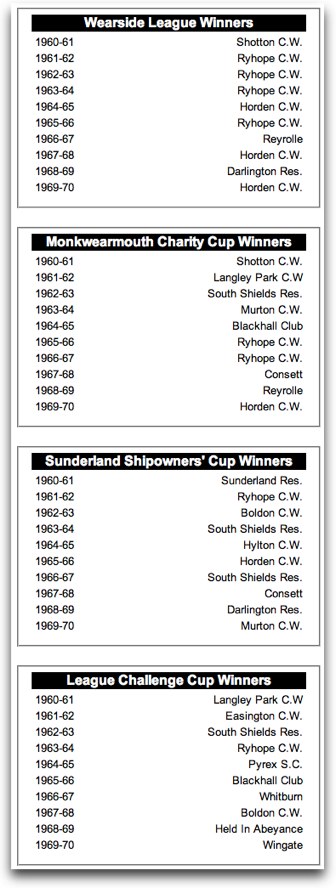
One of the most successful Wearside League clubs in the 1960s was Ryhope CW. In six seasons they won eight trophies, including four championships. In 1961-62 season they won their first league title for 34 years. They remained unbeaten during the season, securing 58 points from a possible 60. In the same year they also won the Shipowners' Cup for the first, and to date, only time.
The following season they retained the championship, but only after a hard struggle. Murton CW had set the early pace and did not suffer their first League defeat until March 30th. In contrast Ryhope took the lead in the table for the first time in the season only five days before the programme ended. At the end of April, Ryhope claimed their tenth successive League win, against Boldon CW. After Boldon's Ernie Johnson had given his side a 3-0 lead with a hat-trick in 13 minutes, Ryhope rallied and snatched the winner late in the game.
Despite a set back in the next match when Langley Park CW hammered them 5-0, Ryhope beat Handon Hold CW in their last game by the same score to clinch the title. In the season's Monkwearmouth Charity Cup Final they were beaten 3-2 by South Shields Reserves before a large crowd at Ryhope. The home side twice drew level through goals from Ridley but failed to get a third past South Shields goalkeeper, Crooks who was in brilliant form.
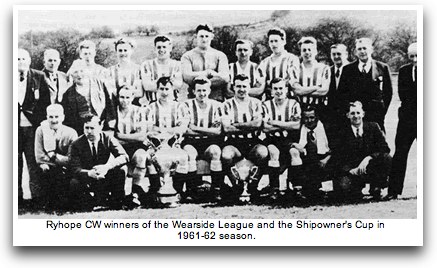
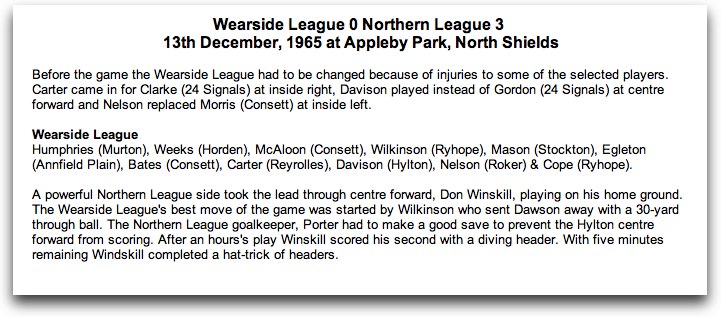
In the 1963-64 season, it was back to their more clear-cut championship performance for Ryhope. They won the League by nine points from Blackball, in the process scoring 126 goals (most in the League) and conceding only 29 (fewest in the League) in 28 games. In the same season they also won the League Cup for the first time.
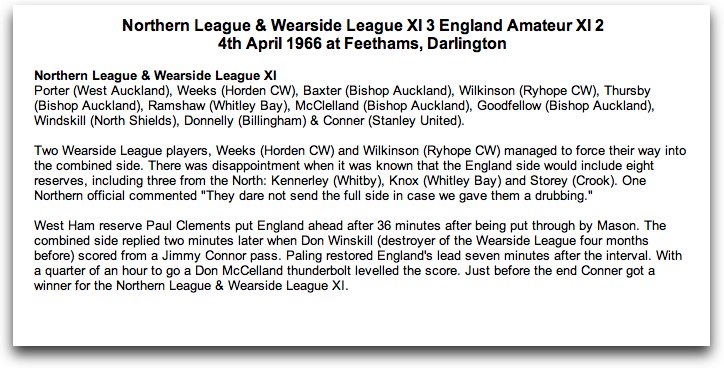
After failing to emulate Royal Rovers' feat at the turn of the century of four successive league titles the following season, Ryhope returned to winning ways in 1965-66 winning both the championship and Monkwearmouth Charity Cup. The following season, Ryhope retained the Monkwearmouth Charity Cup but could "only" finish mid-table in the League.
Just prior to the opening of the 1964-65 season, the North Eastern League was disbanded threatening the existence of several outstanding clubs in the area. The clubs affected sought an emergency meeting with Wearside League officials to see if they could be allowed to join the League. Despite the short notice, these clubs were accommodated and the League was increased from 15 to 20 clubs.
At the end of the season it was two of these newcomers who contested the League title. The championship was not decided until the last games of the season and even then, only goal average could separate Horden CW from Ashington. The climax of the season was Horden CW 3-1 win at Ashington on 26th April.
The final table read:
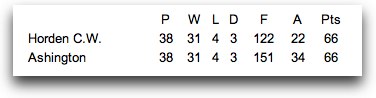
Horden claimed the Wearside League on goal average: 5.545 compared to Ashington's 4.441. If the present system of goal difference had been used at the time, the positions would have been reversed and Ashington would have been champions.
The 24th Signal Regiment's brief Wearside League career was nothing if not eventful. The 1965-66 season was their one and only campaign in the League. After being in the top five places up to Christmas, they fell away, finishing in 16th position. They, however, boasted the League's top marksman in Andrew Gordon with 35 goals. Also, many of their outstanding players were constantly called upon to play in Army representative games, which affected the strength of the side at times.
But they also gave credit to the standard of football in the League, which was of great benefit to their players. And, indeed, gave them the wherewithal to win the British Army Challenge Cup, European Command Challenge Cup, Yorkshire District Challenge Cup, Northern Command Challenge Cup and the Yorkshire District (Army) League Cup all in that season.
At the end of the season the 24th Signals found it necessary to resign from the Wearside League due to the overseas "postings" of Captain Thompson (Football Officer) and the majority of their players from their home base of Catterick Camp.
The 1968-69 season was one of the most weather-affected in the League's history, causing the postponement of 88 games. Permission had to be gained from the Durham FA to extend the season from May 10th to May 24th to enable the League and its Associated Competitions to fulfill their obligations. One casualty, however, was the League Challenge Cup, which was held in abeyance until the following season due to the heavy commitments.
One of the highlights of the season was Consett's victory in the Durham Challenge Cup, becoming the first Wearside League club to win the trophy in the history of the competition.
1970s
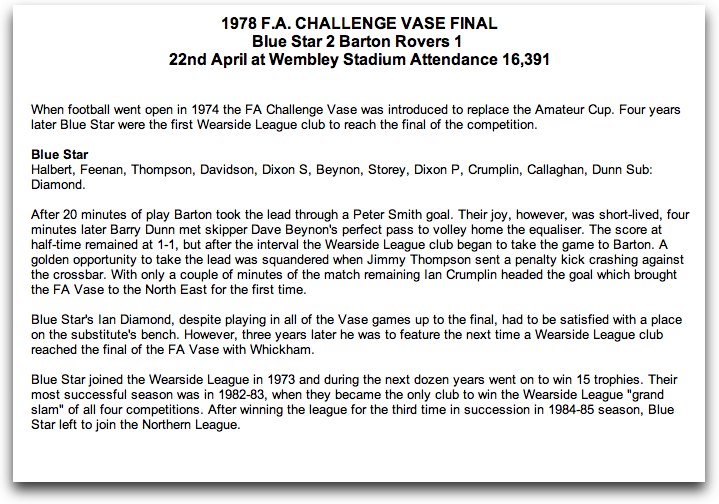
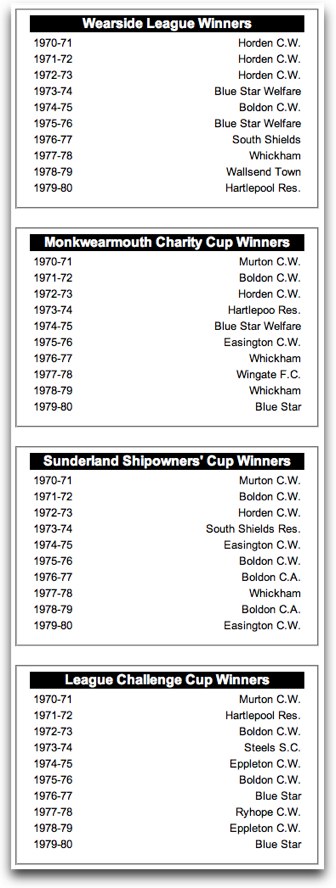
Where Ryhope CW had just failed to equal Royal Rovers record of four league titles in a row, Horden succeeded. Horden's first triumph was in 1969-70 (the club's fourth title) was achieved when they came from behind to pip long-time leaders Consett CW. They also won the Monkwearmouth Charity Cup that season with a 2-0 victory over Murton CW on the Horden Welfare Park. The title was retained the following year, with Gateshead giving the champions a hard fight for most of the season. In the 1971-72 season Horden completed a hat-trick of league titles and also reached the 1 st Round proper of the F. A. Cup. The following season was Horden's most successful ever. Not only did they win the championship for a fourth time, but they also won the Shipowners' Cup and the Monkwearmouth Charity Cup.
Boldon CW were one of the best cup-fighting sides of the 1970's. In 1971-72 they were double cup winners. In the Final of the Shipowners' Cup they beat Washington to carry off the trophy for the first time for 14 years. The following season Boldon CW triumphed in the League Challenge Cup. During the 1974-75 season Boldon CW managed to find the form in the League that they had shown in cup competitions and won their first Wearside League title for twenty years. The next season brought Boldon CW two more trophies: the Shipowners' Cup and League Cup. A change of name to Boldon CA did not stop the accumulation of silverware. The re-titled club retained the Shipowners' Cup in 1976-77 and won it again two years later.
Murton C W performed an outstanding feat in the closing week of the 1970-71 season, when they played four cup ties in six days. Three of these being final ties with one of these and the other game - a semi-final - going to extra time. The outcome was that Murton CW won three trophies: the League Cup, Shipowners' Cup and the Monkwearmouth Charity Cup. This was the first time in the history of the competitions that this had been done.
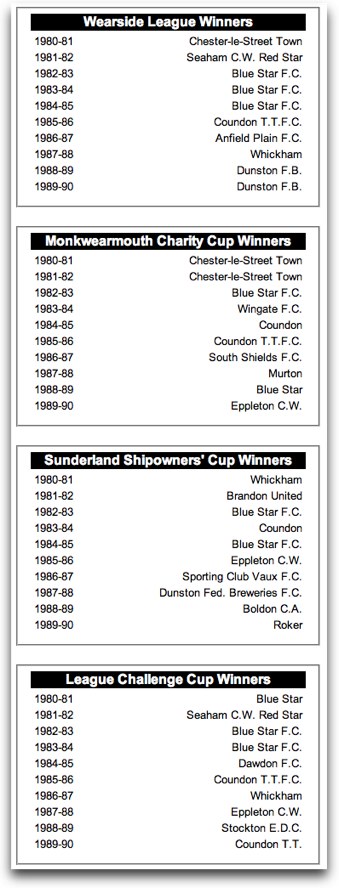
1980s
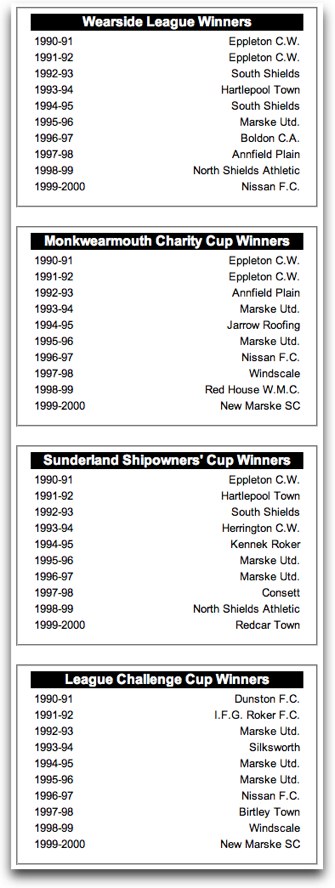
1990s
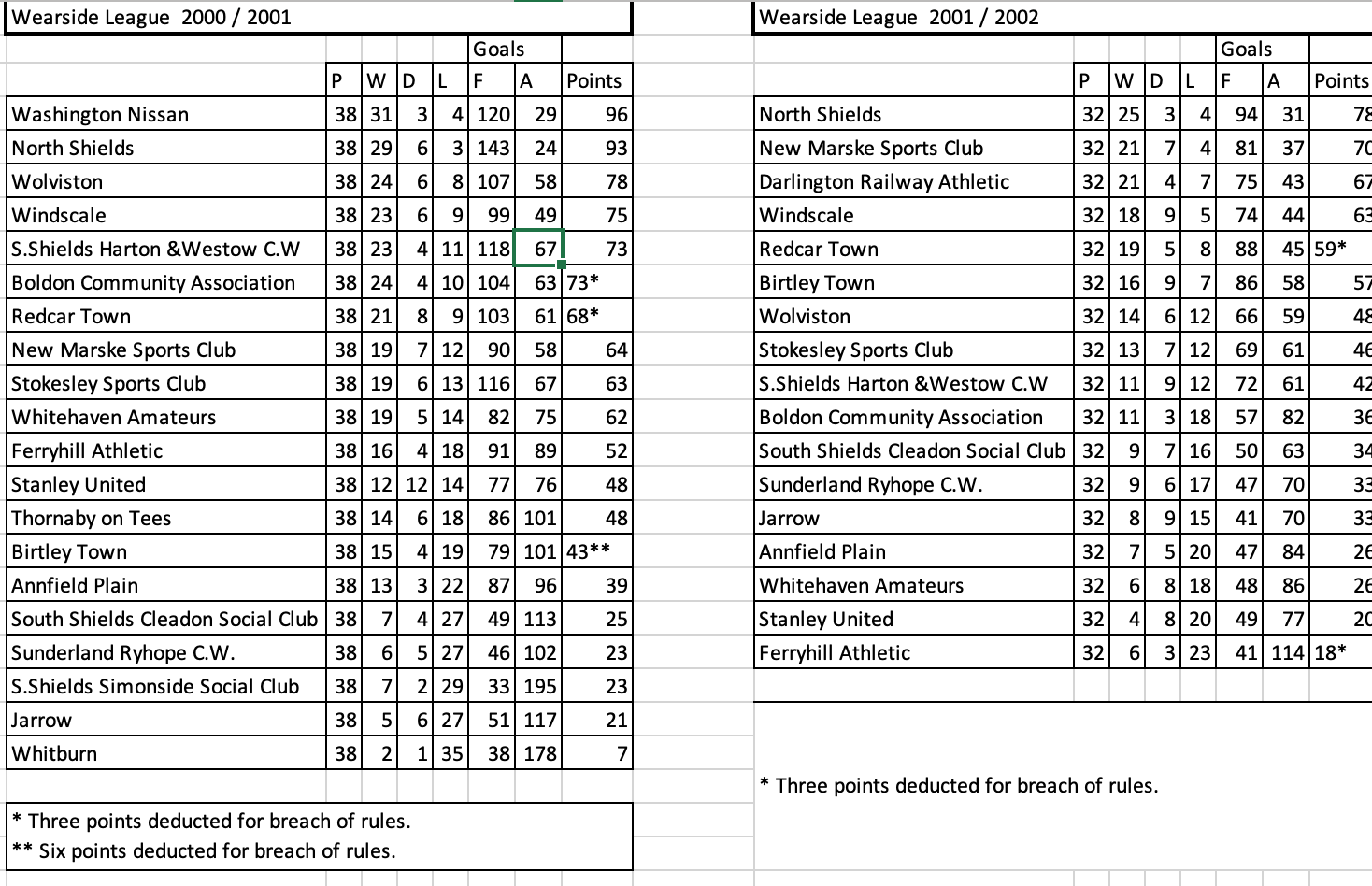
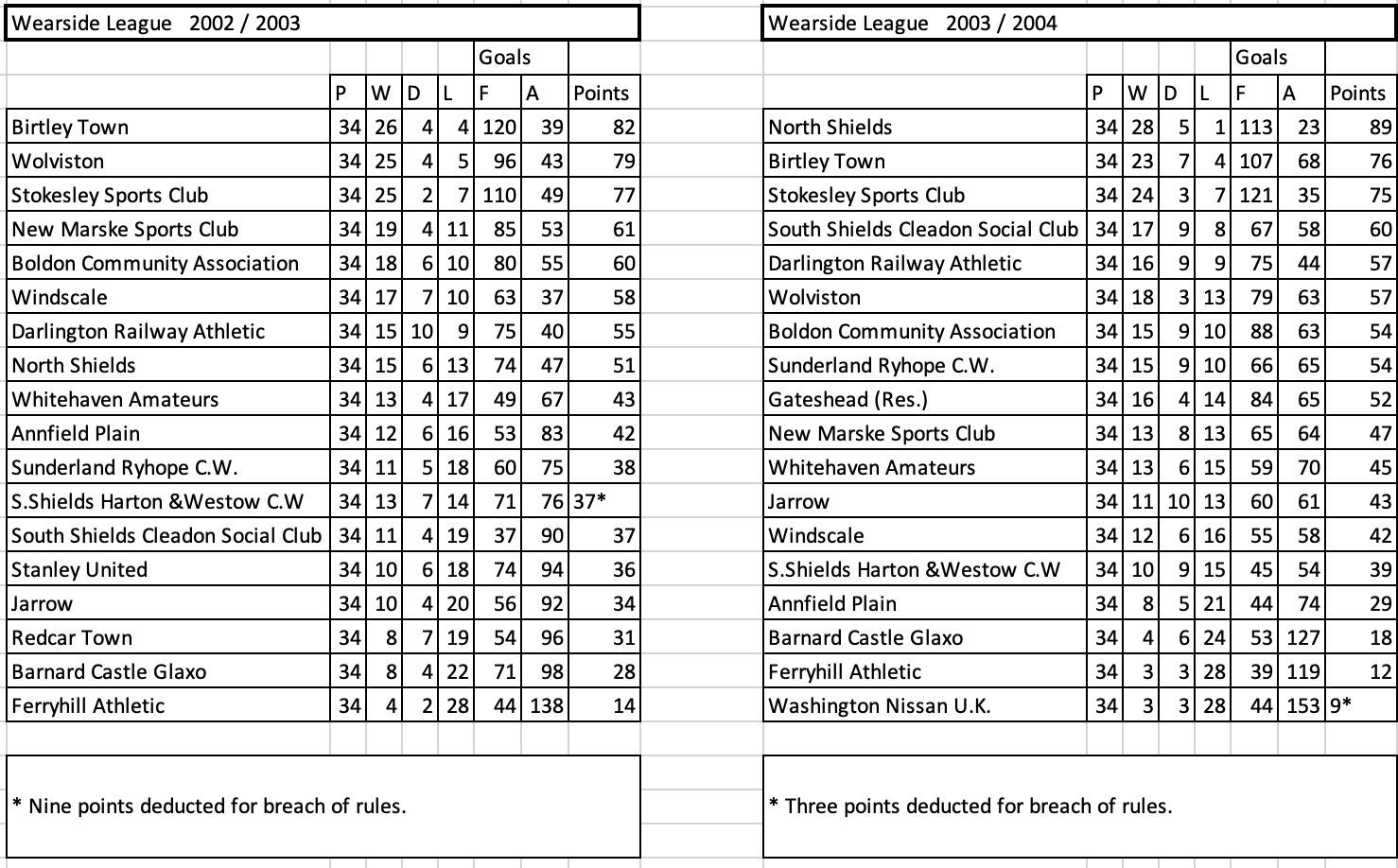
2000's
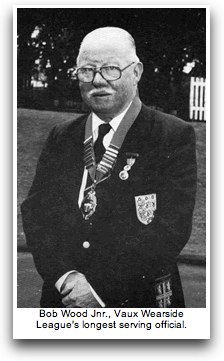
Bob Wood Jnr.
When Bob Wood replaced his father as Wearside League Secretary in 1959, he was no stranger to the post. For most of his life he had helped his father with League business. At times, to save money, Bob used to deliver letters to the doors of referees, thus avoiding postage. This season Bob celebrates his 60th year in the Wearside League.
Bob had a distinguished career as a player, as a young right half he played for Murton CW in the Wearside League. For one mid-week game, he took a taxi from work at Hebburn to Murton. The Murton secretary was not amused when presented with a bill for the taxi fare of 7/6d for expenses.
After some impressive displays for Middlesbrough "A" team, Manager, Peter McWilliam wanted to sign Bob on full-time. When Bob Snr. heard of the Ayresome Park club's intentions, he told his son he could not turn professional. As Bob was serving an engineering apprenticeship at Reyrolles, Bob Snr. did not want his son to follow a precarious football profession. The wisdom of the decision was seen in the fact that Bob worked all his working life at Reyrolles, ending up as Works Manager.
Bob continued to play amateur football, with among others, South Bank, Horden CW and Bishop Auckland. He played in an Amateur international trial and appeared for England against Allied Universities.
He set out on a ref ereeing career in his mid-twenties, advancing through the North Eastern League and Northern League. After spending a couple of seasons on the Football League linesmen's list he was promoted to the referee's list.
During the post-war period Bob was one of the most travelled referees in the League. The only games he could handle involving North East clubs were friendlies, practice matches and testimonials (including Len Shackleton's). Bob was in great demand to take charge of games all over the rest of the country.
Bob won many honours during his career, in 1956 he refereed the Football League v Irish League at St. James' Park. Although he took control of an FA Cup semi final, the Wembley final eluded him. This was not helped by the fact when at his peak Newcastle United reached the final three times in a five-year period, thus disqualifying him from the big occasion.
In stark contrast with today's era of mass dismissals and bookings, its hard to believe that Bob only sent off two players and cautioned six in a 25-year career.
In 1954-55 season Bob was bestowed with the highest honour his profession could give, when he was elected President of the Association of Football League Referees and Linesmen.
In the late-1950s Manager, Harry Potts asked Bob if he would do some scouting for Burnley Football Club. Bob accepted the offer much to the delight of all at Turf Moor. Among the players he discovered for the club was Ralph Coates, who was later transferred to Tottenham Hotspur for a huge fee.
Despite his various careers as; player, referee and scout, Bob still found time for the Wearside League. In fact, it would be fair to say no other man has devoted so much time to the League as Bob Wood Jnr. The only person to approach his contribution would be his father, Bob Snr.
Chairmen
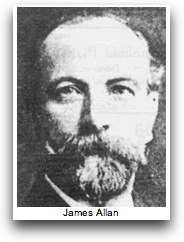
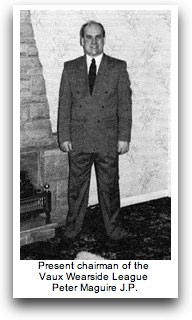
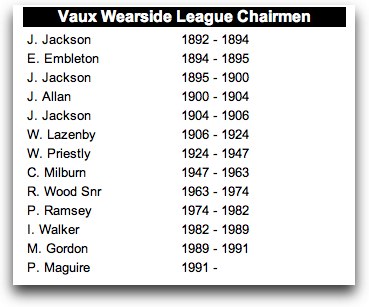
When James Allan was apponted chairman of the Wearside League at the turn of the century, they had in charge the man who brought football to Sunderland.
Born in Ayreshire, Allan studied at Glasgow University. He came to Wearside to take up a teaching post at Hendon Board School. Finding football was not played in the town he set about introducing the "dribbling" code, popular north of the border, to Sunderland. He organised a meeting with some of his colleagues in October 1879 from which the Sunderland and District Teachers' Association Football Club was formed. When the club was opened up to players outside the teaching profession the club became Sunderland AFC.
His involvement with the club in these early days included periods as: captain, secretary, committee man and treasurer.
It was while at this post that Allan took over the chairmanship of the Wearside League. Allan was also on the committees of the Monkwearmouth Charity Cup, Indepedent Committee of the Shipowners' Cup and the Schools' Swimming, Football and Sports Committees.
Presidents
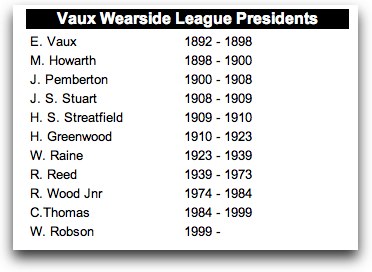
The honour of being the first president of the Wearside League was bestowed upon Major Ernest Vaux.
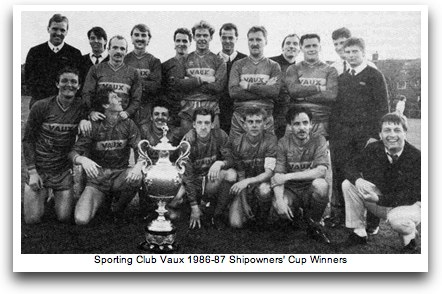
The Major's grandfather, Cuthbert Vaux founded the famous brewery in 1805. Not only does the brewery still exist today, but now sponsors the Wearside League.
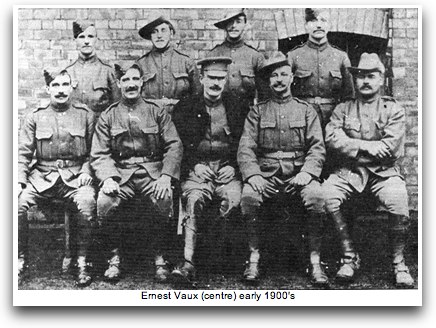
At the end of Vaux' s presidency of the Wearside League he left for South Africa to fight in the Boer War. Commanding the Maxim Gun Detachment (made up of men from the region) the major took part in over 80 engagements. He was mentioned in despatches on more than one occasion and he was promoted to the rank of Captain.
On June 12th 1901, at a special meeting of the Town Council, Ernest Vaux was among a number of veterans of the war who were made Honorary Freemen of the Borough. The family brewery celebrated Ernest's return by brewing the famous "Maxim Ale" in his honour. This was thought to be the first bottled brown ale in the country. In 1938 this was re-named "Double Maxim" and is still on sale today, yet another reminder of the Wearside League's first president.
In the years following Vaux's departure, the League presidency was held by a number of Sunderland M.P.'s. Pemberton, Stuart, Greenwood and Raine were all Parliamentarians when taking up office.
In 1939 this tradition was ended with the election of Lieutenant Colonel Reed, who was to remain as League president for over thirty years.
In 1964 Bob Wood Jnr. took over the presidency, after being League chairman for ten years.
Since 1984 the League president has been Charles Thomas, who is also a vice-president of the FA. He is the former manager of South Shields, Horden and Shildon.
Secretaries
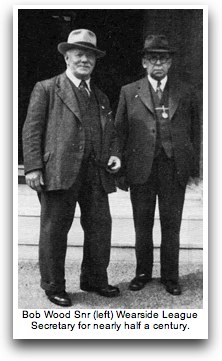
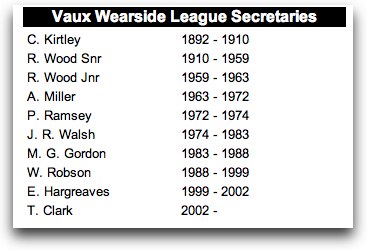
Father of the Wearside League, Charles Kirtley, remained secretary through the difficult early years right through to 1910, by which time the league was firmly established. Then for over half a century the post of secretary was in the capable hands of the Wood family: Bob and son Robert Junior. Even then, this did not reflect the true period of involvement of the Woods with the Wearside League.
In the early years of the League, Bob Snr. had been a player, referee, club representative and member of the management committee before becoming secretary. Bob Jnr., had served a 27 year apprenticeship as Assistant Secretary before taking over from his father. He then went on to become Chairman in 1963 and President in 1974, a post he was to remain at until 1984.
Bob Snr., played his early football with a number of different teams. He started his career with a junior club Roker Park, then going on to play for Havelock, White Star Juniors, Elm House, Eastern Star and Sunderland Swifts.
His days at Swifts brought him into contact with the Wearside League for the first time. In 1899-1900 season he was playing full back for another League club, Royal Rovers. In his first season the team finished runners-up to South Hylton. In 1900-01 Rovers won the League, Shipowners' Cup and Monkwearmouth Charity Cup and repeated the feat the following season. During Christmas 1902 Bob found himself out of work and he moved to Middlesbrough with a promise of a job. During a brief stay on Teesside he played one game for Middlesbrough "A" team but returned to Sunderland when he found work in the town. On his return he joined Wearside League club Southwick. At the end of the 1902-03 campaign Southwick tied with Royal Rovers for the championship, only for his former club to take the title after two deciding matches. After only six months with his new club Bob was appointed secretary.
In September 1904 the Sunderland Daily Echo reported "There is no better-known or more popular secretary and player - for he still dons the pants and jersey when it is necessary - than "Bobler" Wood."
Bob rose through the League management until 1910, when he was given the daunting task of filling the shoes of Charles Kirtley as Secretary of the Wearside League. He was not to disappoint those who had placed their faith in him, serving the League for the next 49 years.